
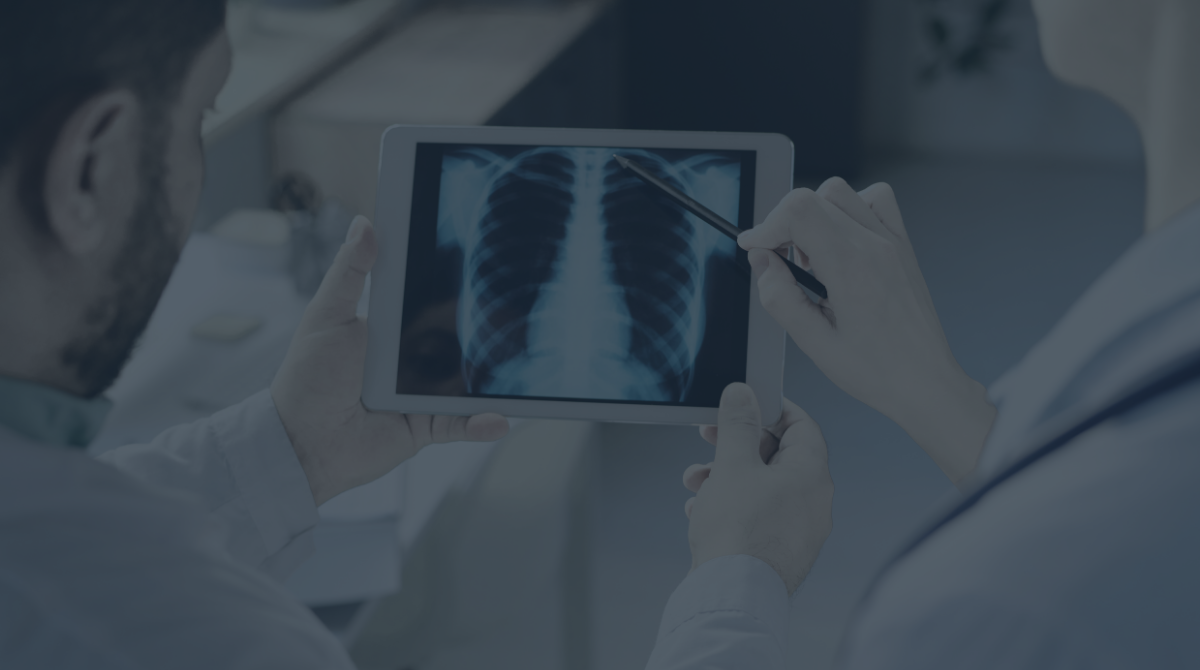
Seeing Every Case, and Knowing What to Say - How we are rebuilding FRCR 2B preparation at Revise Radiology

Koshy Jacob
June 16th, 2026
This article first appeared as a post by Dr Koshy Jacob on LinkedIn. We're sharing it here in full, in his own words.
When I prepared for my FRCR 2B many years ago, two quite separate worries sat with me throughout, and although I did not always put them into words at the time, I have since come to believe that they sit with almost every candidate who walks into that exam.
The first worry was simply not knowing whether I had seen enough. There was no reliable way to be sure that I had encountered a case of every condition that might come up, or even the majority of them, and so however many hours I put into practice there was always a quiet doubt running underneath it that something unfamiliar would appear on the day and catch me out. I could work hard, but I could not work with any confidence that my effort was complete, because nobody could tell me where the edges of the syllabus actually were in practice.
The second worry was different, and in some ways it was the harder of the two. Even where I had genuinely seen a condition during my years of radiology training, that did not mean I knew how to present it under the particular pressure of the viva. Knowing something and being able to demonstrate that you know it, clearly and calmly, while an examiner watches and interrupts, are not the same skill at all. The viva is as much a test of technique as it is of knowledge, and that is a truth that catches out a great many capable radiologists.
Why I am writing this
I learned the distinction between those two worries the hard way, because I failed the 2B at my first attempt.
When I look back honestly at that failure, it was not really a failure of knowledge. I passed the rapid reporting and I passed the long cases, both of which I had a technique for and felt comfortable with. It was the viva that let me down, and it did so through a combination of poor technique and plain nerves rather than any great gap in what I knew. I knew the radiology. I simply could not show it well enough on the day.
When I sat the exam for the second time, two things had changed, and I think it is important to be precise about both of them because they map exactly onto the two worries I described. The first was that I had spent the six months between my attempts deliberately working on how I presented, on the way I structured my answers and carried myself, rather than only on adding more facts. The second was that in that same period I had seen a very large number of cases, far more than I had before, so that very little felt genuinely unfamiliar when I sat down in front of the examiners. Both of those things mattered, and together they were enough. I passed.
That experience, more than any other, is what the latest piece of work at Revise Radiology has been built around, because once you see clearly that there are two separate problems, it becomes obvious that they need two separate answers.
The first answer: coverage
The first problem is coverage, by which I mean the confidence that you have actually seen a case of everything you might reasonably be tested on. This is the problem we have now set out to solve for our FRCR 2B Mastery Course, and I am genuinely pleased with where it has landed.
We began with the asset that we have spent many years and a great deal of money building, which is our full bank of more than twenty-two thousand worked-up cases. That breadth is a real and unusual advantage, but I have always been honest, including in these posts, that it is also a problem in its own right. A bank of that size is overwhelming. No candidate can sensibly work through twenty-two thousand cases, and the value was never going to come from the sheer volume. It was always going to come from choosing the right cases and presenting them properly, which is a quite different and much harder task than simply accumulating more.
So rather than continuing to collect, we set out to curate. From that full bank we selected a focused master set of 2,944 cases, and we organised them into three teaching formats that each do a distinct job in preparation. There are viva cases and short cases, roughly eleven hundred of each, and a further set of spotters designed for the rapid pattern recognition that the exam also demands. Importantly, every one of those cases carries a complete work-up, with observations, interpretation, a principal diagnosis, a differential diagnosis and management, so that a candidate is rehearsing the entire thought process rather than simply learning to attach a name to an image.
The part of this work that I am most proud of, though, is not the size of the curated library but the fact that we can now demonstrate what it covers. We mapped the whole master set, condition by condition, against the radiology curriculum, and separately against a composite international blueprint of high-yield diagnoses drawn from the major fellowship examinations around the world. Both of those checks returned complete coverage, with no gaps across any system or subspecialty.
What that means in plain terms is this. Anyone who works through the Mastery Course can be assured that they have seen a case of every condition that is likely to turn up in the exam. That is a simple sentence to write, but it describes an assurance that simply did not exist when I was a candidate, and which I would have valued enormously. It removes the first of my two worries almost entirely, because the doubt about whether you have seen enough is replaced by the knowledge that the library has been deliberately built so that nothing important is missing.
There is a lesson buried in how those cases are weighted that I think is worth drawing out, because it runs against the instinct of many candidates. The selection leans deliberately towards conditions of average difficulty rather than towards the rare and the exotic. The reason is that candidates fail far more often on common conditions presented plainly than on the obscure syndromes that everyone spends their evenings worrying about. I know this better than most, because the case that contributed to my own first failure was a straightforward presentation of heart failure, something I saw every single working day, which I overcomplicated in the moment because I was convinced the examiners must be showing me something far more clever than what was actually in front of me.
The second answer: technique
Coverage, however, is only half of the story, and it would be dishonest to suggest otherwise. Seeing a case of every condition is necessary, but it is not sufficient, because the viva does not simply ask whether you recognise something. It asks you to present it clearly and confidently while under real pressure, and that is a skill entirely of its own.
This is the part that I think is least understood by candidates, and it is the part that caught me out. Good technique in the viva is not only about speaking English fluently, although that certainly helps and matters. It is about knowing what is important to say and, just as crucially, what is better left unsaid, because a candidate who says too much will often talk themselves into trouble. It is about structuring an answer so that the most significant finding comes first and the reasoning follows in a logical order. And it is about carrying yourself as someone who is confident and in control, even when you are not entirely certain, because the examiners are forming a judgement about whether they would trust you as a colleague reporting independently. Those qualities are what separated my first attempt from my second, far more than any change in my underlying knowledge.
Technique of this kind cannot be acquired simply by looking at more images, however many of them you see. It has to be practised, watched, corrected and practised again, ideally in front of others and under conditions that resemble the real thing closely enough to be uncomfortable. A candidate who has seen every condition but has never rehearsed how to present under pressure is only half prepared, and may well underperform relative to what they actually know.
This is precisely where the rest of what we do comes in, and why I see it as the natural companion to the coverage work rather than as a separate offering. Our daily viva sessions and our live courses exist specifically to build that presentation technique, to give candidates the repeated, deliberate practice of sitting in the hot seat, structuring their thoughts, and being challenged in a way that mirrors the exam. The aim is straightforward. A candidate who has both seen the cases, through the curated and curriculum-complete library, and learned how to present them, through that deliberate practice, walks into the exam with their chance of passing pushed much closer to a hundred per cent than it would be with either piece on its own.
Two halves of the same thing
When I put it like that, the shape of what we are building becomes clear. Coverage and technique are not competing priorities or alternative products. They are two halves of the same thing, and a candidate genuinely needs both. The coverage gives them the confidence that nothing on the day will be wholly unfamiliar. The technique gives them the ability to show what they know when it counts. My own journey through the 2B, the failure and then the pass, is really just a story about acquiring both of those things, one painful step at a time and largely by my own trial and error.
What we are trying to do now is offer both deliberately, as a designed and demonstrable preparation, rather than leaving the second of them to chance the way I was forced to. That feels to me like a meaningful shift in how we think about exam preparation, and an honest one, because it acknowledges that knowing your radiology and passing the viva are related but distinct achievements.
What comes next
None of this is finished, and I am always wary of pretending otherwise, because the truth is that we will keep refining all of it as candidates use it and tell us what genuinely helps and what does not. We have built it the way we build everything, by listening, trying things, and adjusting in response to real feedback rather than assuming we have it right first time.
But it represents the foundation for where we are heading more broadly. Our Mastery courses are moving to a structured cohort model from September, bringing the coverage and the technique together into a single, coherent programme, and there is more to come after that which I will write about separately in due course.
If you are preparing for the 2B, my one piece of advice, drawn entirely from my own experience, is to take both halves seriously. Make sure you have seen the cases and make sure you have practised how to present them. Neither alone will get you there. Together, they very nearly guarantee it.
Originally published by Dr Koshy Jacob on LinkedIn. Read and follow the original post here: View on LinkedIn